By the jungle house, the night was warm and quiet, and the crickets played so loudly that nobody really needed to whisper. On the veranda sat Alfred, Zofia, Patrycja, and Agata, who was so sunk into her chair that she looked like part of it.
From inside the house came odd sounds again and again.
“Do you hear that?” Patrycja whispered.
“I hear it,” Zofia murmured. “That’s the third round of gymnastics in an hour.”
Alfred pushed his glasses up his nose and looked through the window. Kuba stood by the hammock, doing very serious squats. Then jumps. Then something that looked like dancing, though it probably was not.
“I saw earlier,” Patrycja said softly, “that he was sticking tape over his eyelids.”
Silence fell.
“Tape?” Zofia repeated.
“Tape,” Patrycja confirmed.
Alfred set down his tea and narrowed his eyes.
“He’s frightened,” he said quietly.
Agata, who had been so still everyone had nearly forgotten she was there, lifted her head. She stood up calmly, smoothed her dress, and looked toward the hammock.
“I know,” she said. “I’ll talk to him.”
Agata walked over to Kuba without hurrying. Kuba had just finished his squats and was pretending to study something very interesting in the dark jungle.
“Kuba,” said Agata.
“Mm?”
“What are you doing?”
“Gymnastics,” said Kuba with great seriousness. “Evening gymnastics. I always do that.”
“You never do that,” said Agata.
Kuba was quiet for a moment.
“Maybe I’m starting a new habit.”
Agata sat on the edge of the hammock and looked at him kindly. Kuba held the gaze for about five seconds.
“All right,” he muttered, sitting beside her. “I just… don’t really feel like sleeping.”
“You’re afraid of that dream,” Agata said.
Kuba shrugged. Then he nodded.
“That storm. And I almost fell off the little bridge. And I don’t know what comes next. What if this time the dream is worse?”
Agata said nothing for a moment.
“Sometimes I get scared too,” she said at last. “Before I go into a dark cave, I always stop at the entrance for a little while. Nobody sees it—but I do.”
Kuba looked at her.
“Really?”
“Really.” Agata nodded. “But I go in anyway. Because I know I’m not alone.”
Three shadows appeared on the veranda. Alfred, Zofia, and Patrycja came over quietly and sat nearby.
“Kuba,” said Patrycja, “I really want to know whether that powder worked. Whether the clouds thickened. Whether rain fell on Laurenty’s island. Only you can find out.”
“Because it’s your dream,” Zofia added.
“And we’re here,” Alfred said to comfort him. “All of us.”
Kuba looked at his friends. Alfred was already holding a mug of warm milk, steaming gently, with a spoon of honey and a smell so soothing that Kuba’s eyes wanted to close all by themselves.
“Special milk for a good sleep,” said Alfred.
Kuba took the mug and drank slowly. Then he climbed into the hammock and looked up at the sky.
“All right,” he murmured. “But if anything happens, wake me.”
No one answered, because Kuba was already asleep.
He expected a ship. He expected a storm, high waves, and wind in the sails.
Instead, there was only the sky.
A vast blue sky full of sunshine, and far below it a white carpet of clouds. Kuba felt wind under his wings and for a moment could not understand where they had come from.
Then he realized he was Ala.
In dreams, that felt perfectly normal.
She saw everything through sharp, quick eyes that could turn in every direction. And because of them, Kuba noticed two tiny figures on hang gliders far ahead, floating calmly over the sea of clouds.
Patrycja and Ruda Panda.
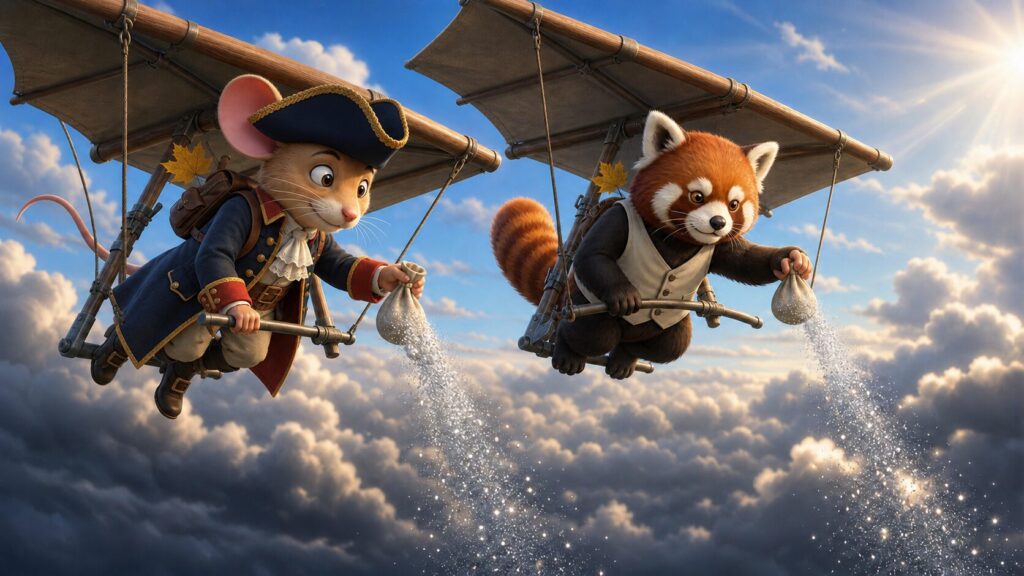
Patrycja held a bag of silver powder and leaned over the clouds, sprinkling it slowly and carefully. Ruda Panda flew on her left and did the same.
“Keep to this side!” Patrycja called. “The clouds are thicker here.”
“I see,” Ruda Panda replied. “And I also see that you’re as calm as ever when you’re doing something for the first time and don’t know what will happen.”
Patrycja was silent for a moment.
“That means I’m focused,” she said at last.
The flight was beautiful.
The clouds looked like one giant white pillow, and the sun shone from the side, turning every cloud into a little mountain with a golden peak. Kuba, as Ala, circled peacefully beside the gliders and watched the route.
Then he saw the cranes.
They were coming from the left—large, gray, perfectly lined up, fast and certain—straight toward Patrycja.
“Look out!” Kuba shouted in Ala’s voice.
Patrycja turned her head. She saw them. She jerked the glider hard to the right so suddenly that the bag of powder swung in the air and leaned dangerously far out—but Patrycja caught it at the last second with her other paw.
The cranes flew by just inches away. One of them—the one closest to her—turned its head and stared at Patrycja with clear surprise, opening its long beak wide.
“Sorry!” Patrycja called.
The crane did not answer. The cranes flew on, calm and dignified, as if nothing had happened.
Ruda Panda was silent for a moment. Then she burst into laughter—so loudly that her glider trembled.
“Focused,” she choked out between laughs. “Very focused.”
Patrycja adjusted the bag and pretended not to hear.
They flew on for a little while longer, over darker clouds, over air that smelled different now—wetter and heavier.
Then Patrycja looked into the bag.
“It’s gone,” she said calmly.
Ruda Panda checked hers.
“Mine too.”
They both lifted their heads and looked down. Beneath them the clouds had turned dark—deep navy, heavy, swollen. The air seemed to tremble.
“Look,” Ruda Panda whispered.
“I see,” Patrycja answered.
And for a moment they simply watched. Kuba, as Ala, watched with them.
“We’re going back to the ship,” Patrycja decided.
Ala flew ahead, through the wind, through the chill, down toward the masts of a ship rocking gently on the sea.
On deck, everyone stood by the railing with telescopes.
Laurenty was in the middle. He gripped the rail so tightly it looked as if he were afraid of drifting away. He stared toward his island.
Patrycja and Ruda Panda landed on the deck. No one spoke. Everyone looked at the same point on the horizon.
The first raindrop fell on the deck right by Laurenty’s feet.
Then the second.
And then the sky over Laurenty’s island opened wide, and rain fell—big, warm, real rain. From far away it looked like a gray curtain dropping over the island’s green.
Laurenty stared without moving.
Then he turned to the detectives. He wanted to say something—he opened his mouth—but for a moment no sound came out.
“Thank you,” he whispered at last.
Kuba nodded.
Ala sat on Kuba’s shoulder and stayed silent too, which was extremely rare for her, and everyone noticed.
The storm passed quickly, as storms do when rain has waited a long time to fall.
And after the storm came a rainbow. Huge and colorful, stretched over the whole island from one edge to the other. Ala immediately flew toward it to see whether one could pass through. It turned out that one could.
The detectives reached the shore in a small boat. Laurenty walked ahead—through wet grass, between trees still dripping from the rain—until they came to a wide clearing where the island’s people were already waiting.
The tables were full. There were huge red fruits that looked like watermelons but tasted sweeter. There were yellow little balls that smelled like sweets and tasted like mango. There were pancakes with coconut and honey, fresh juices in bright bowls, and slices of papaya arranged like a sun on a giant leaf.
Kuba stopped by the table and narrowed his eyes at something orange and juicy.
“What is that?” he asked.
“Papaya,” Laurenty explained.
Kuba took a piece. He looked at it. He smelled it. He ate it.
“Vitamins,” he murmured with great seriousness. “Lots of vitamins.”
Everyone laughed so hard that the birds in the nearby trees flew up into the air.
The celebration lasted a long time. There was dancing and music, stories and lanterns when evening fell. Laurenty told the island people about the detectives, and they listened with wide-open eyes. Ala learned a new word in the island language and repeated it at every possible moment, putting it into every sentence no matter whether it made sense or not.
Tuptuś wrote everything down in his notebook—including a recipe for three dishes, the names of five fruits, and the word Ala had learned.
Kuba ate two more pieces and was very pleased with himself.
Then he sat quietly at the table and felt the evening wind from the lake brush his mane. Warm, light, pleasant.
And suddenly—under his back—he felt something cool and rough.
Sand.
The music in the dream was still playing, and voices were still laughing—but the sand was real. Kuba felt the lake wind from both sides at once: the one from the dream and the real one from the beach.
He squinted.
The music faded slowly.
Laurenty waved goodbye from the shore.
Kuba smiled in his sleep—and slept on.
Kuba opened his eyes.
Above him was the sky. Morning, pink, with one thin cloud stretching lazily over the water.
Under him was sand.
Kuba was lying on the beach. Not in the hammock. Not in the house. On the beach—with his paws tucked under his head and a very content look on his face.
For a moment he did not move.
Then he sat up and looked around.
Alfred stood nearby with a cup of tea and wore the expression of someone who had had a very long night.
“Why am I lying on the beach?” Kuba asked.
“Because you woke up in the middle of the night,” Alfred replied calmly. “You started flapping your arms like wings, left the house, walked through the jungle, and lay down here. Face up to the sky.”
Kuba squinted.
“I was flapping my arms?”
“Like a bird,” Alfred confirmed. “I jumped out of the way at the last second.”
“We all tried to carry you back,” Zofia added, coming over with a cup of juice. “But you’re very heavy.”
“We all tried,” Patrycja agreed.
“Even me,” said Ala from a nearby palm tree.
Kuba sat in silence for a while and looked at the lake. Then he turned to Alfred.
“It rained,” he said with a smile.
“I know,” Alfred answered. Then he sat down beside him on the sand with his tea in his paw. “Tell us everything.”
The sun rose slowly over the lake. Somewhere in the jungle, birds were waking up. On the beach sat a little group of friends listening as Kuba told them about flying above the clouds, about the cranes, about the silver powder, and about the rain that had finally fallen on Laurenty’s island.
And about the papaya too. He told them that as well.
Because those really were excellent vitamins.
Kuba paused for a moment and looked at the faces of his friends, lit by the first rays of the sun. He took a deep breath of the fresh morning air.
“Agata,” he began gently, sending her a warm smile, “you were right yesterday about that dark cave. When you know that in the morning such friends will be waiting for you, even the biggest storm in a dream is not scary at all.”
Agata smiled without speaking. Because sometimes, when the most important words have been said, nothing more needs to be added.
📖 Masz ochotę poczytać te opowiadania dziecku z prawdziwej książki?
Zajrzyj do naszego sklepu!
🎁 Teraz z kodem KUBA – wysyłka do paczkomatu gratis.