Kuba opened one eye.
Something was wrong with the shutter on the left side of the cabin window. He had noticed it when he went to sleep, but he was too tired and had told himself, I’ll check it tomorrow.
Well. Tomorrow had arrived, and the shutter was reminding him of that very loudly.
Outside, a storm was raging. The wind howled like a flock of angry owls, rain drummed on the deck, and the waves rocked the ship so hard that the teacup slid off the little table and rolled across the cabin floor. Kuba looked at the cup. The cup looked at Kuba.
“Before dawn, a captain always checks the ship,” he muttered to himself. “A captain never forgets. A captain is alert, brave, and… all right, fine, this captain simply forgot the shutter.”
He sat up in his bunk and stretched hard. Then he stood up, because Kuba never, ever skipped morning exercise. Not on a ship. Not during a storm.
Ten squats. One, two, three… The ship swayed with every squat, so Kuba looked a bit like someone trying to exercise on a swing. Eight, nine, ten. Ten push-ups. Five bends. Done.
He put on his captain’s hat — black, with a wide brim and a golden buckle, definitely better than an ordinary safari hat — then pulled on his boots and long raincoat. He looked exactly like a captain should during a storm. Dignified and serious, even though his hair under the hat was sticking up in three different directions.
He left the cabin.
Rain hit his face at once. Cold, wet, and very unpleasant. Kuba narrowed his eyes and hurried along the deck, holding onto the ropes stretched there so people could steady themselves during bad weather.
By the big wheel of the ship, the wooden steering wheel with handles all around it, stood Alfred the Anteater.
He stood calmly. Unmoved. Rain dripped from his nose. The wind tugged at his long tail. Alfred kept the ship on course.
“Alfred!” Kuba shouted over the wind. “Is everything all right?”
“Yes, Captain,” Alfred answered in his slow, calm voice. “The night was hard. But there were no surprises. Course maintained.”
“Good work,” said Kuba, patting him on the shoulder. “I’ll take over at the wheel in an hour.”
Alfred nodded and did not budge. That was Alfred — as calm as a lake on a windless day, even when there was a storm all around.
Kuba looked up.
High above, at the top of the main mast, was a little basket made of planks — sailors called it the crow’s nest, because it looked a bit like a giant nest, except instead of a bird, a sailor sat in it and looked through a spyglass at the sea. It was the highest place on the ship, where you could see the farthest — the shore, other ships, a coral reef, everything.
In the crow’s nest sat Ala the Parrot.
Well, actually — she was almost lying down, covered with one wing like a blanket.
“Ala!” Kuba roared.
“Mhm,” Ala replied.
“Ala, can you see the shore or any other ships?”
Ala straightened with a sigh so deep it could be heard even through the wind.
“Visibility is very poor, Captain!” she called. “But the clouds are moving west. In about half an hour it should clear up.”
“Good. Keep watch. Ruda Panda will replace you soon.”
At the sound of her name, a reddish little face with black patches around the eyes appeared from below deck. Ruda Panda — the team’s new friend, who had joined the expedition only a few weeks earlier. She had an unusual talent: she could sense metal fittings in boxes and chests buried underground, because her nose — though not as long as Alfred’s — was very sensitive to the smell of rust and metal. She also loved digging, which made her invaluable on treasure hunts.
“I’m ready, Captain,” she said, wagging her fluffy tail.
“In fifteen minutes, go up the mast,” said Kuba. “And bring Ala something warm for her beak.”
“Yes, Captain!” the panda replied.
Kuba headed toward the bridge.
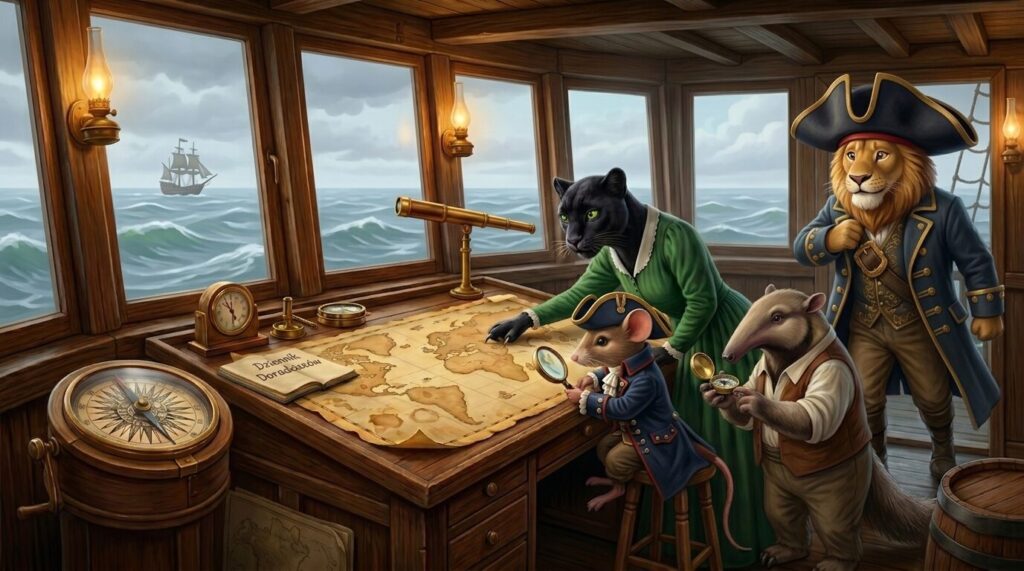
The bridge was a special place on a ship — a bit like the brain of the whole expedition. There was a table with maps, a compass, measuring tools, a notebook full of notes, and usually someone very focused, looking at all of it at once. On their ship, that someone was Patrycja the Mouse.
At least, at that moment there were two people there. Leaning over the map beside Patrycja was Agata the Black Panther — Kuba’s cousin. Agata had joined the mission because, like the rest of the crew, she believed the book of elixirs must never fall into the wrong hands. Her younger years spent at sea with her uncle had made her excellent at navigation. She had come to the bridge just before Kuba to replace the tired Patrycja after the night watch.
Patrycja sat at the large table, where an old map lay spread out. It had yellowed edges and brown coffee stains.
The previous owner’s coffee. Not Patrycja’s. Patrycja never kept coffee near maps.
Through a magnifying glass, she stared at a tiny marking in the middle of the ocean. Beside her, Agata traced a claw along the coordinate lines.
“How’s the course?” Kuba asked, stepping in and shaking rain from his coat. “I came a little early. I’m planning to relieve Alfred at the wheel soon.”
“Course is correct,” Agata answered in her deep, calm voice, briefly lifting her eyes from the map. “We are here.” She tapped the map with her claw. “Wild Boars Island is here.” Another tap, a little farther on. “With good wind, we’ll arrive before sunset.”
Kuba leaned over the map. Wild Boars Island. Small, with a jagged coastline, marked rocks, and one large hill in the center.
“Tell me about the treasure again,” he said.
Patrycja set down the magnifying glass and looked at him.
“While looking through old books in the harbor library,” she began, “I found a mention. In a very old book, written in tiny letters, there was a chapter about Wild Boars Island. And one sentence that stopped me: ‘Here lies the book of formulas, which must not be opened by the unworthy.’”
“Formulas,” Kuba repeated.
“Recipes for elixirs,” said Patrycja. “Secret, very powerful elixirs.” She lowered her voice. “Remember the lake elixir that made anyone who drank the water fall in love with the first person they saw?”
Kuba shivered. He remembered.
“Or the one from the land of marmots,” Patrycja continued, “that turned everyone’s paws pink?”
“If that book contains recipes for dozens of elixirs like those,” Patrycja said very seriously, “and it falls into the wrong hands… the consequences could be truly unpredictable. Imagine someone pouring an elixir into a river. Or spraying it into the rain.”
Silence. Only wind and waves.
“Szakal Szymon knows about the book,” she added quietly.
Kuba clenched his teeth.
“That’s why we set sail,” he said.
“That’s why we set sail,” Patrycja agreed. “And now I’m leaving the bridge in Agata’s excellent paws and going to sleep for two hours, because I stood here all night. I’ll just stop by Zofia’s first — she’s on kitchen duty.”
Zofia — a giraffe who had to move around the ship in a permanent half-crouch because the masts were too low for her — was on duty in the kitchen. Under her calm watch, badgers were cooking morning porridge. Three badgers, one pot, and four different opinions about how many raisins should go into it. Zofia soothed the argument with perfect patience.
“Don’t worry, leave the toppings to me,” Kuba heard her say through the wall as he left the bridge.
Kuba stood by the wheel beside Alfred and took hold of the big wooden circle with both paws.
“Go rest, Alfred,” he said. “Good job.”
Alfred nodded, but before he walked away, he paused.
“Kuba. I sense something in the air. Something… different. I have a vial ready,” he said, and then left.
Kuba looked out at the sea.
The sky was beginning to brighten in the east. The clouds were indeed parting. The wind was weakening. After the long storm, the sea was slowly calming, though it was still rough and gray.
Kuba thought about the book of elixirs. About Szakal Szymon. About Wild Boars Island.
“Ship on the port side!” came a piercing cry from above.
Kuba straightened at once.
“Everyone to the bridge!” he roared.
Within a minute, everyone gathered. Patrycja with her notebook (she hadn’t even had time to lie down), Alfred with a vial near his nose, Zofia bending her neck in the doorway, Ruda Panda who jumped down from the mast in one smooth movement… and of course Agata, who was already there, watching the horizon carefully.
Kuba raised the spyglass to his eye, a long brass tube through which distant things look very close.
And he saw a ship.
Large. Three-masted. With swollen sails. It was sailing parallel to them, about half a mile to the left.
“There’s no flag,” said Kuba.
“A flag is a banner,” Patrycja explained at once, looking through her smaller spyglass. “Every ship has one to show where it comes from or who it belongs to. This ship has no flag. That’s suspicious.”
“It looks old,” Zofia murmured. “Very old. Those sail shapes, that hull…”
“Like drawings,” said Alfred slowly. “From books about ancient sea voyages.”
“Santa María,” said Patrycja suddenly.
Everyone looked at her.
“Books describe a ship called Santa María,” Patrycja explained. “Christopher Columbus sailed on it. Europeans said he discovered America — but people had lived there for thousands of years already. It was simply their home.”
“It’s a bit like someone coming into our jungle and saying, I discovered this jungle!” Ala muttered from above.
“Exactly,” said Patrycja.
Kuba nodded. Then he looked through the spyglass again.
“Doesn’t matter who it belongs to,” he said. “That ship has no flag, it’s following our course, and it’s heading for the island.” He lowered the spyglass. “Raise the pirate flag.”
Alfred narrowed one eye.
“The pirate flag?”
“Skull and crossbones,” Kuba said firmly. “When other ships see that flag, they’d rather not mess with us. It’s an old sea custom — a flag of fear.” He looked at the crew. “Prepare the cannons. And get ready to board.”
“What’s boarding?” Ruda Panda whispered to Alfred.
“That’s when one ship sails very close to another,” Alfred explained calmly. “Sailors throw iron hooks on ropes onto the other deck, pull the ships together, and jump across. To talk. Or to stop someone from escaping.”
“Oh,” said Ruda Panda. “Like jumping over a fence, only on the sea.”
“And with a bigger chance of getting wet,” added Alfred.
Kuba put the spyglass to his eye again.
Agata stood beside him. She took out her own sailor’s spyglass and narrowed her green eyes.
“He’s sailing unusually high,” she said softly.
“What do you mean?” Kuba asked without taking his eyes off the mysterious hull.
“Look at the waterline,” Agata said, pointing to the place where the hull met the sea. “That line shows how heavily the ship is loaded. This ship barely touches the water. It’s almost empty.”
“Why is that important?” Kuba asked.
“Because empty ships are usually looking for something,” Agata replied darkly. “Treasure or loot to fill their holds. It’s a hunter, Kuba.”
The other ship did not slow down. It did not turn. It kept on its course.
And then, slowly, very slowly, a flag appeared on its mast.
Black. With a white skull.
Exactly the same as theirs.
That is not a good sign, Kuba thought.
And just then he felt a tug on his shoulder.
He ignored it. The other ship was more important.
A second tug. Harder.
“Alfred,” Kuba began without taking his eye from the spyglass, “why aren’t you at—”
“Kuba.”
It was Patrycja’s voice. But not the one from the bridge. Another one. Closer. As if from somewhere completely different.
“Kuba, wake up. Breakfast.”
“Kuba,” said Alfred’s voice. “The ant cookies will get cold.”
Kuba opened his eyes.
A hammock swayed gently beneath him. Below it, a lake murmured softly. Above him were palm trees and a blue sky. The sun shone warmly. In the distance, Ala screeched that her seeds were not colorful enough.
Kuba sat still for a moment.
“I had a dream,” he said at last.
Patrycja stood nearby with a glass of lemonade. Alfred held a plate of cookies.
“Will you tell us?” Patrycja asked.
Kuba looked at the lake. Then at the jungle. Then at his paws — ordinary, not pink.
“I think so,” he said slowly. “But I need to sort everything out in my head first. Because that wasn’t an ordinary dream. It was something more.”
Patrycja raised an eyebrow and reached for her notebook.
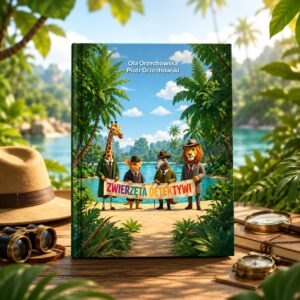
📖 Masz ochotę poczytać te opowiadania dziecku z prawdziwej książki?
Zajrzyj do naszego sklepu!
🎁 Teraz z kodem KUBA – wysyłka do paczkomatu gratis.