
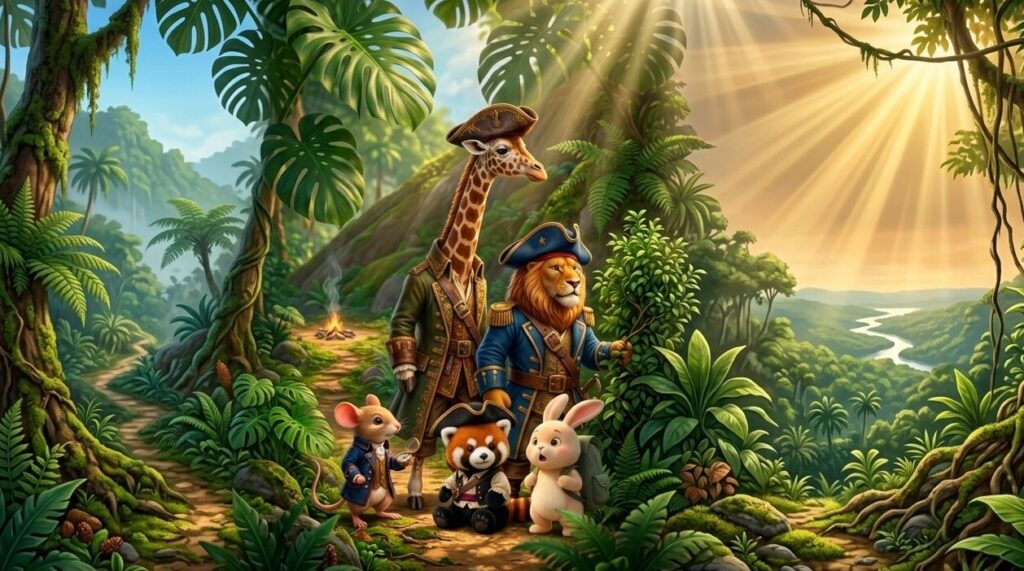
Kuba was standing by the anvil and working hard. He wore a leather apron and held a hammer in his hand. The iron in front of him glowed bright red. He was a blacksmith, and he was just fitting a horseshoe onto a horse.
Then he heard footsteps behind him. Heavy footsteps. Confident footsteps. Metal footsteps.
Kuba turned around.
In front of him stood a knight. He was tall, dressed in silver armor, with his visor lowered halfway. But it was the eyes that made Kuba stare. Yellow eyes. Clever eyes. Somehow, he had seen them before.
“I want golden horseshoes,” said the knight.
“Golden?” Kuba narrowed his eyes. “Gold is too soft. The horse would slip on every turn.”
“It doesn’t matter. I want gold. Make them.”
“I won’t.”
The knight laughed. His laugh was sharp, unpleasant, and strangely familiar.
“Then I won’t pay. For anything.” He waved his hand at the finished horseshoes. “Goodbye, blacksmith.”
And he walked away, clanking in his armor.
“Hey!” Kuba shouted. “Come back here! That’s stealing!”
But the knight was already gone around the corner.
Crash.
Kuba opened his eyes.
A cabin. A ship. The creak of wood and the sound of waves.
Beside his bed stood Patrycja with a cup of tea and a smile she was trying very hard to hide.
“Captain Kuba,” she said, “you snored like a cannon again.”
“I dreamed I was a blacksmith,” Kuba muttered. “A customer came, wanted golden horseshoes, and refused to pay for anything.”
“Kuba,” Patrycja said patiently, “you are not a blacksmith. You are a ship captain.”
“Pirate captain,” added Ala from the window, without opening her eyes. She was curled up like a blanket, covered by her wing.
“Ala, I told you to take watch,” said Kuba.
“I am on watch,” Ala mumbled. “Inner watch. I’m guarding the cabin.”
Kuba put on his hat and stepped onto the deck.
Agata was standing by the maps. Dark circles shaded her eyes, but she stood straight.
“That ship,” Kuba said from the doorway.
“It sailed on,” Agata replied. “It didn’t even change course. Storm, darkness, high waves—we were invisible to them. Or maybe they had more important matters on the other side of the island.”
“What were they doing all that time?”
“I don’t know,” Agata said calmly. “But we’ll find out later.” She gave a small smile. “We waited until it disappeared beyond the horizon. That’s why you slept so late. And why you snored like a cannon.”
“I do not snore like a cannon,” Kuba said with dignity.
“Captain,” Alfred said from the door, walking in with a plate of ant cookies, “I heard you from the kitchen.”
“The kitchen is on the other side of the ship,” Kuba said.
“Exactly,” said Alfred.
There was a short silence.
“Go rest, Agata,” Kuba said. “Your watch is over. The watch is the duty of keeping guard on the ship—each sailor takes a few hours so someone is always looking out. Now it’s my turn.”
Agata nodded gratefully and left.
Kuba studied the map.
Wild Pigs Island. A rough shape, rocky shores, a hill in the middle. And a tiny X—the hiding place of the chest with the Book of Potions.
Just then, a shout rang out from the crow’s nest.
“Smoke!” yelled Ruda Panda. “I see smoke from the island!”
Kuba rushed onto the deck. White clouds were rising above the green band of jungle—three quick puffs, a pause, then three more.
Patrycja was already beside him with a spyglass.
“Regular,” she muttered. “Someone is doing it on purpose.”
“That’s Morse code!” said Ruda Panda, sliding down the mast.
“Not quite,” said Zofia, leaning out from the kitchen with a ladle in her hand. “Morse code was invented long after pirate times.”
Everyone stared at her.
“How do you know?” asked Ruda Panda.
“I read,” Zofia said, and went back to the kitchen.
Silence.
“I read too,” Patrycja muttered, opening her notebook. “Those are smoke signals. Three short puffs with a pause—almost everywhere and always, they mean one thing: I’m here, I need help.”
“Someone is calling for help,” said Kuba. “We’re going there.”
They came ashore. Kuba, Patrycja, Zofia, and Ruda Panda went onto the island. Alfred, Agata, and Ala stayed on the ship.
“Be careful,” Alfred called, wrinkling his nose toward the island. “After yesterday’s chase after that mysterious ship in the storm, we need to be extra careful.”
Kuba stood on the beach and looked around. Thick jungle. Huge trees. Bright birds shouting from the branches. The smell of flowers and sweet fruit.
And then that strange feeling.
“This jungle,” he said slowly, “is a bit like ours. Just without the little house. And without the hammock.”
“Especially the hammock,” he added after a moment.
“Let’s focus,” said Patrycja, heading forward with her magnifying glass.
Ruda Panda moved to the front, sniffing the ground every few steps.
“Actually,” she asked suddenly, “why is this called Wild Pigs Island?”
“Because long ago the first sailors saw little black animals running along the beach from their ship,” Patrycja explained. “They looked a bit like pigs, so they wrote that name in their book. Every next sailor read the same book and repeated the same name. No one asked the people who lived here what they called their home.”
“And the pigs?” Ruda Panda asked.
“They’re gone now,” Patrycja said softly. “Only the name remains.”
“And the island’s real name?” Ruda Panda asked.
They walked farther inland, following Ruda Panda.
After twenty minutes, Ruda Panda suddenly stopped and raised her paw. They were very close to a now-burned-out campfire—the source of the smoke signals.
A noise came from the bushes. Loud, messy, and ending with a clear:
“Ow.”
Out of the leaves rolled a big backpack, with the corner of a thick Family Cipher Dictionary sticking out of it. Behind the backpack rolled its owner—a little Rabbit with a twig between his ears. He landed on his back, legs in the air.
Everyone stared.
The Rabbit stared back.
“Hi,” he said uncertainly.
“Hi,” said Kuba.
The Rabbit tried to stand, but the backpack was too heavy. He toppled over again. Zofia calmly stepped forward and set him back on his feet.
“Thank you,” he murmured, adjusting his glasses. “I’m Tuptuś. Rabbit Tuptuś. I was sending smoke signals since dawn. I was afraid nobody would notice.”
“We noticed,” said Ruda Panda.
Tuptuś let out such a deep sigh of relief that he nearly sat down again.
“What are you doing here alone?” Patrycja asked.
“That’s a long story,” said Tuptuś.
“We have time,” said Kuba, sitting on a rock.
Tuptuś had an unusual gift—he could read old books written in forgotten languages and ciphers. His great-grandmother had taught him, and she had learned from her own great-grandmother. He was traveling on a ship of scholars with other learned people.
Then one night, he saw something troubling. One of the sailors, by candlelight, was copying a map—the map with Wild Pigs Island marked on it. Tuptuś hid behind a barrel and watched, hardly daring to breathe. The sailor was very careful, copying every detail, every line, every mark. When he was done, he released a pigeon through the cargo hatch window.
“A carrier pigeon,” Patrycja explained. “In olden times, messages were sent that way. A letter was tied to a bird’s leg, and the pigeon flew straight to the receiver.”
“I knew who it was going to,” said Tuptuś quietly.
“To Szakal Szymon,” Kuba said.
Tuptuś nodded.
“The sailor was his spy—someone who pretends to be a friend but gathers information for an enemy. Szakal needs me, because without someone who can read the cipher in the Book of Potions, the treasure is useless to him. I didn’t sleep all night. When the ship stopped at the island to take on water, I slipped away. I said I was going to gather fruit, and I never came back. I hid and waited. Then I heard from the seagulls that you were sailing this way, so I sent the smoke signals.”
Kuba looked at Patrycja. Patrycja looked at Kuba.
“You’re under our protection,” Kuba said. “From now on.”
Tuptuś smiled for the first time since the conversation began.
They continued into the island together. Tuptuś said the chest should be near the hill of three boulders—three dark rocks rising at the top like fingers.
Ruda Panda led the way. Tuptuś trotted beside her, adjusting his glasses every few seconds and looking around nervously.
“How do you do that?” he asked at last, watching Ruda Panda. “The way you sniff the ground.”
“Every metal has its own smell,” said Ruda Panda without slowing down. “Old iron smells like rust and rain. Gold smells different—cooler, sweeter. Copper smells sharp. I learned from a young age.”
“That’s a bit like me with languages,” Tuptuś said.
“Exactly,” said Ruda Panda, and they both nodded with clear respect for one another.
“Kuba—do you smell anything?” came a voice.
Ruda Panda stopped. She inhaled. Once. Twice. Three times.
“Metal,” she said slowly. “Rusty fittings from a chest. Somewhere close.” She blinked. “But there’s something else. Another smell. Unfamiliar.”
And then a green-red flare shot from the sky.
Before Kuba could even think—Ala landed on his shoulder with such force that she nearly knocked off his hat.
“Alfred sent me!” she shouted into his ear. “I smell old wood, gunpowder, and something familiar from the side of the island. He told you all to be very careful!”
“Ala,” Kuba said, once his heart had returned to its place, “did you have to land so enthusiastically?”
“A messenger must be fast,” she said with dignity, and settled more comfortably on his shoulder.
Patrycja was writing quickly. “Old wood, gunpowder, something familiar. Alfred has a good nose. We have to be alert.”
And then—there was a rustle from the bushes on the left.
Everyone froze.
Silence.
Again—the rustle. Closer this time.
“It’s probably the wind,” Kuba said, though his voice trembled slightly.
“There is no wind,” Zofia said calmly.
Ruda Panda drew in the air.
“That smell,” she whispered. “That unfamiliar smell. It’s here.”
Kuba straightened, adjusted his hat, and took a step toward the bushes.
“We know you’re there,” he said loudly and confidently. “Come out.”
The bushes did not move.
Five seconds. Ten.
And then—
Plum.
Kuba opened his eyes.
Something hard was lying on his stomach. Above him swayed palm leaves. The hammock creaked lazily.
Kuba looked down.
A coconut.
“Ow,” he said, a little late.
Alfred’s calm laughter came from the terrace.
“I heard that,” Alfred said.
“A coconut fell on my stomach,” Kuba said with dignity.
“That too,” said Alfred.
Kuba sat in the hammock for a moment, holding the coconut and staring up into the palm leaves.
“I had a dream inside a dream,” he said at last. “And I woke up exactly at the worst moment.”
“Will you tell us?” Patrycja asked, coming out of the house with her notebook. Alfred sat down on the steps of the terrace. Zofia set down her book.
“Yes,” said Kuba. “But it began with a blacksmith. And with someone who refused to pay.” He narrowed his eyes. “And he had a very familiar laugh.”
Alfred slowly sniffed the evening air. Patrycja was already writing.
And somewhere in the jungle—far beyond the trees—a bird cried out.