
Alfred opened one eye.
It was warm. Pleasantly warm, even though polar night lay beyond the thin icy wall of the igloo. A small oil lamp cast a golden glow over the snowy walls. Alfred was tucked under three blankets and felt perfectly cozy.
He got up, pushed aside the ice block that served as a door, and peered outside.
Darkness. The northern lights danced across the sky in green and violet streaks. In front of him stretched the ice floe, and on it stood two penguins. They were motionless and looked at him so seriously, as if they were waiting for an important meeting.
Behind the ice floe, in the black water, a polar bear floated calmly.
Alfred stood in the doorway for a moment.
Then he scratched his nose.
Wait a minute, he thought. What is an anteater doing in the Arctic? That is suspicious enough. But more importantly, what are penguins doing here?
Every child knows—and if not, now they will learn—that penguins live in Antarctica. That is the southern end of the Earth, the coldest place on the planet, surrounded by the Southern Ocean. And polar bears live in the Arctic—that is, at the northern end of the Earth, beyond the Arctic Circle, among ice and fjords. Those two places are on opposite sides of the globe. A penguin and a polar bear could never meet in real life.
And yet here they are, standing together and looking at me.
Which means…
Alfred narrowed his eyes.
Is this a dream?
“Dad,” said a voice.
Alfred blinked.
“Dad, but it was supposed to be Kuba’s dream.”
Dad cleared his throat.
“Oh yes,” he said. “You’re right, Ola. I guess we got a little mixed up. Sorry, Alfred.”
From under the blanket came a calm voice.
“It’s all right.”
“We’re going back to Kuba’s dream,” said Dad. “To pirate adventures on Wild Pig Island. We start exactly where we left off…”
The bushes stood still.
Five seconds. Ten.
Kuba straightened up, took a deep breath, and with one decisive movement pushed the branches aside.
There was no one behind the bushes.
He turned back to the group. A smile appeared on his face—part relief, part pride.
“I guess it was only the wind,” he said.
But Ruda Panda stood still, eyes half-closed and nose raised. She inhaled slowly, methodically, layer by layer.
“There is a scent,” she said quietly. “Unfamiliar. Someone was here.”
Ala circled above the bushes, making small loops.
“I saw it,” she said calmly, dipping lower. “The bushes moved, then something went between the trees. I didn’t have time to see what.”
Patrycja was already kneeling by the bushes with a magnifying glass to her eye. She moved it centimeter by centimeter along the ground.
“Tracks,” she muttered. “Small, light ones. The depth of the print tells us the weight—whoever it was wasn’t big. The spacing of the steps—slow and careful, not running.” She stood and pointed the magnifying glass at the shrub. “And this.”
On a thorny branch hung two threads. Thin, dark brown.
“A piece of clothing,” said Patrycja, taking out her notebook. “Someone pushed through the bushes and left a trace behind.”
“Dark brown, thick fabric,” she added. “Let’s remember that. When we find someone wearing dark brown clothing, we’ll know it’s them.”
“So someone was following us,” said Kuba.
“Deliberately and carefully,” Patrycja confirmed.
Kuba looked into the depths of the jungle. The trees stood dense and silent.
“We follow the trail,” he said.
Ruda Panda went first, nose to the ground, tail held high like a little flag. Every few steps she stopped, sniffed a leaf or a patch of earth, and silently pointed the direction with her paw.
Behind her walked Kuba, Patrycja, and Zofia. Tuptuś trotted at the end, stubbornly keeping up, though his backpack pulled him backward with every step like an anchor.
The path led down the slope, through thicker and thicker undergrowth. The leaves were huge like umbrellas, and the tree roots rose from the ground like giant fingers.
After a few minutes, Ruda Panda stopped at a wet, muddy area.
“This way,” she muttered.
Ala flew over the marsh and came back.
“There’s an exit on the left,” she said. “From above, I can see a dry path. But it’s longer.”
“We go through the middle,” Kuba decided.
Ala nodded with the expression of someone who knew that would happen.
They crossed one by one, carefully searching for dry places. Kuba made it across. Patrycja made it across. Zofia crossed with admirable grace, as if she did it every day. Tuptuś took two sure steps, then a third—and his left paw sank into the mud with a loud, unmistakable:
Splash.
Everyone turned.
Tuptuś stood with one paw stuck in the mud and a philosophical look on his face.
“I left my own track,” he said calmly.
“A very clear one,” Patrycja agreed, writing it down.
Kuba looked at him for a moment and cleared his throat.
“Maybe I should carry the backpack,” he offered.
Tuptuś stopped and straightened up with the look of someone whose feelings had just been lightly bruised.
“I carry it myself,” he said shortly.
“It’s heavy,” Kuba observed.
“I know.”
“Did your great-grandmother say so?” Kuba asked.
Tuptuś adjusted his glasses.
“Exactly,” he said, and marched onward with renewed determination.
A few minutes later, Ruda Panda stopped sharply beside a large gray boulder.
She sniffed around it from every side. Then she shook her head.
“The scent is fading,” she said with clear frustration. “The wind has changed direction.”
Everyone stopped. Kuba looked around helplessly. The boulder was large, and the path on both sides looked exactly the same.
Then Tuptuś raised a paw shyly.
“Sorry,” he said. “But over there, to the right of the boulder, there are broken twigs. At the same height as the threads on that bush.”
Everyone looked.
It was true. Three thin branches, snapped cleanly, at the height of a small animal.
“How did you know to look there?” Kuba asked.
Tuptuś pushed up his glasses.
“I read about it,” he said. “In the third or maybe fourth book. I’m not exactly sure which, because I had both of them in my backpack at the same time and got them mixed up.”
“Good job, Tuptuś,” said Patrycja, writing something in her notebook.
Tuptuś stood up so straight that his backpack nearly tipped him backward.
They went on, following broken twigs and barely visible paw prints.
Until they reached a stream.
Ruda Panda stood on the bank. She inhaled. Once, twice, three times. Then she slowly lowered her nose and shook her head.
“The trail ends here,” she said. “The scent stops at the water.”
Patrycja crouched and studied the stony bottom of the stream.
“Someone went into the water,” she said. “It’s an old trick—water washes away tracks and scent better than anything else. Detectives have known that for centuries, so clever escapees know it too.” She stood and dusted her paws. “We need to check both banks. If they went in here, they must have come out somewhere.”
They split up. Kuba and Tuptuś checked the right bank, Patrycja and Zofia the left. Ruda Panda walked along the water itself, stopping every now and then.
After a few minutes they returned to the same spot.
Nothing.
Kuba narrowed his eyes and stared at the water.
“Clever,” he said at last. His voice held as much annoyance as respect.
Patrycja spread the map on a flat stone by the stream. Tuptuś crouched beside her, adjusting his glasses and immediately looking like someone who knew exactly what he was doing.
“The map is encoded,” he said. “The numbers by each place show the order. The small symbols along the paths are the directions of the world—this sign is east, this one is north.”
Patrycja moved her magnifying glass over the center of the map.
“There’s an X here,” she said. “And a message: Three steps east of the stone heart, two north of the place where the trees grow together.”
For a moment everyone stared at the map.
“Stone heart,” Ruda Panda repeated slowly. “A heart-shaped boulder. I saw one like that by the stream when we were looking for tracks.”
“Excellent,” said Patrycja. “But before we return to the boulder—how do we know where east and north are?”
Ruda Panda suddenly lifted a paw.
“Wait,” she said. “The map says east and north. But we can’t see the sun. The trees block everything. Shouldn’t we use a compass instead of guessing?”
Patrycja nodded in approval.
“We have a compass and we will use it,” she said. “But a good detective should also know how to find direction without one. A compass can be lost. Or broken. Nature is always nearby. In Europe, you can observe moss—it grows mainly on the north side of rocks and trees, because it is cooler and wetter there. But in the jungle, moss grows everywhere, so you need to look for other clues.”
Zofia, who had been studying the treetops for quite some time, spoke calmly:
“The tree crowns. Jungle trees reach toward the light. Here, in the Caribbean—north of the equator—the sun is on the southern side. So the crowns are denser on the south and thinner on the north.” She pointed to a tree above them. “That side is south. That side is north.”
Everyone raised their heads. The difference was subtle, but once you knew what to look for, it was clear.
“And ravines and low places,” Patrycja continued, “are cooler and wetter on the north side, so the vegetation there is darker and thicker.”
“Alfred once mentioned anthills too—we’ll ask him when we get back to the ship,” Kuba added.
Kuba looked around the jungle. He glanced at the treetops. At the hollow by the stream—darker and thicker on one side. At an old stone by the path, where a large anthill rose on one side.
“There,” he said, pointing confidently.
Ruda Panda inhaled and nodded.
“That’s right,” she said. “I can feel the cooler air from that side too.”
Tuptuś watched them in admiration and quickly wrote something in a small notebook he pulled from the side pocket of his backpack.
“I’m writing it down,” he muttered. “Just in case.”
They returned to the heart-shaped boulder.
It stood by the stream, gray and mossy, uneven—but when you looked from the right angle, the shape was clear. Rounded at the top, narrowing at the bottom.
“Three steps east,” said Patrycja.
Kuba counted three steps.
“Two north.”
Kuba took two steps. He stopped and looked down at his feet.
Ruda Panda approached, crouched, and began sniffing the ground in little circles, each smaller and slower than the last.
“Here,” she said at last, placing her paw on the ground.
Kuba crouched and began digging with his hands. The earth was soft, as if someone had already disturbed it before.
After a moment, his paws hit wood.
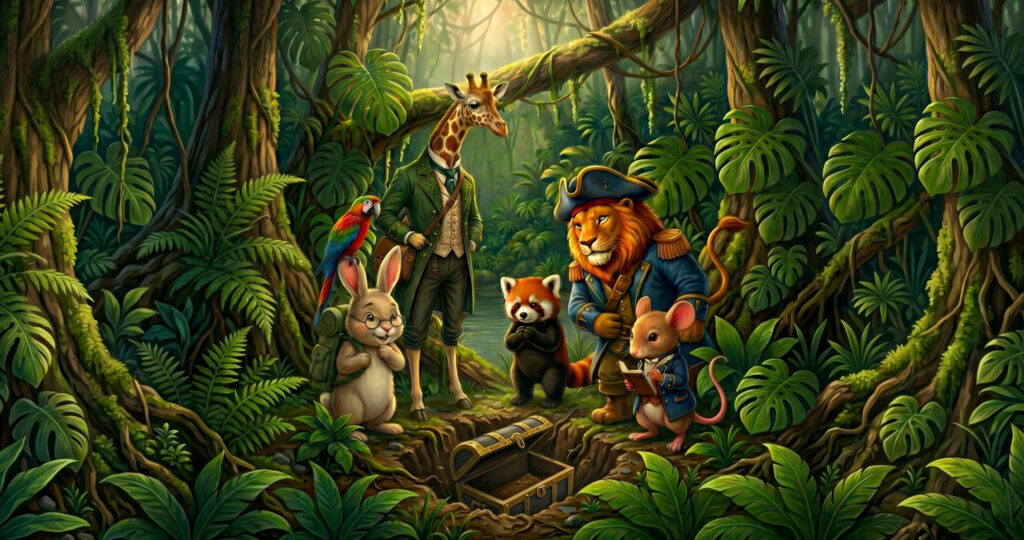
The box was old. Very old. The wood was dark and damp, with rusty iron fittings, and the lock had long since crumbled. Kuba carefully lifted it out and placed it on the stone.
Everyone gathered around.
Kuba looked at Patrycja. Patrycja nodded.
Kuba opened the lid.
Empty.
Silence.
Tuptuś sighed so deeply that his backpack made him lean forward a little.
But Patrycja was already bending over the box with her magnifying glass, not inside it—on the lid. On the inside, carved with a sharp tool, was a drawing. A simple sketch of a hill with three distinctive rocks at the top. And a small circle marked near the base of the hill, on the left side.
“A clue,” said Patrycja softly.
“Someone was here before us,” said Kuba.
Patrycja shone the magnifying glass over the drawing and leaned closer.
“These marks,” she said slowly, “are newer than the box. The wood around them is lighter, the line is sharp, with no trace of dampness. The box is at least several decades old. This drawing—maybe a few weeks.”
Everyone was silent.
“Someone found this box before us,” said Tuptuś quietly. “And left a clue.”
“Or,” said Kuba, “someone wants us to keep going. In the right direction.”
“Or into a trap,” muttered Zofia calmly.
No one answered, because everyone was thinking the same thing.
Ala sat on the edge of the box and tilted her head left and right.
“I saw that hill,” she said. “From the air. Those three rocks are on the east side.” She flapped her wings. “And something glitters there.”
Kuba slowly raised his eyes to the hill visible above the treetops. Three dark rocks on the summit stood like fingers.
Somewhere there—between the trees on the slope—something flashed again.
Quick and brief, as if glass had caught the light.
A telescope.
Kuba stared at that spot for a moment longer. But the flash did not happen again.
Szakal Szymon tucked away the telescope and smiled.
Kuba took a step toward the hill…
and felt something cold on his nose.
Then a second drop. A third.
Raindrops.
Kuba opened his eyes.
Palm leaves swayed above the hammock. From the sky fell a light, warm, May rain. Drops drummed on the large banana leaves near the house and ran in little streams down to the ground.
“Noooo!” Kuba said to the sky.
The sky did not answer. But the rain clearly sped up.
Alfred stood at the entrance to the terrace with an umbrella spread calmly over his head and the expression of someone who had known this for quite some time.
“I told you this morning it was going to rain,” he said.
“You didn’t,” said Kuba, stepping onto the terrace and shaking drops from his hat.
“I told myself,” Alfred admitted. “But I did say it.”
Kuba sat on the terrace steps and watched the rain drum on the jungle leaves. Patrycja came out of the house with a cup of hot tea and silently placed it beside Kuba. Zofia returned to her book. Ala curled up under the eaves and pretended not to hear the rain.
Alfred sat down beside Kuba.
After a moment of silence, he asked gently:
“Did you have that dream again?”
“Yes,” said Kuba.
“And what happened this time?”
Kuba held the cup in both paws and watched the drops sliding off the banana leaves.
“We were close,” he said at last. “Someone was on the island before us. He left a clue in an empty box. And he was watching us from far away.”
Alfred slowly nodded, as if this were no surprise.
“And now?” he asked.
“We’ll go back,” said Kuba. “Next time we’ll make it to the hill.”
Warm rain fell.
And Kuba could already not wait for the next nap.